Tuesday, March 16, 2010

The 186th Montreal St. Patrick’s Parade

It's St. Patrick's Week! For this Irish Dancer (of French descent, but as they say "Everybody's Irish on St. Paddy's day!"), this means Parades and shows.

This crazily busy week began on Sunday, with the
Montréal St. Patrick’s Parade, which is the longest running parade in Canada. Of course, as this was our school's first parade (as the Young Academy of Irish Dance - most of us dancers have been doing the parade for seven or more years), it had to rain!

Dancers from the Young Academy of Irish Dance, Montreal St. Patrick’s Parade 2010

Because of the weather, we all wore transparent plastic ponchos, but heads and arms still got wet and with the wind chill, it was freezing cold. Also due to the rain, we (older dancers) all wore old dresses we did not mind getting wet. I was going to wear either my Teal Solo or my old green skirt with the school t-shirt over a black long sleeved tee when I remembered my raspberry dress.


Raspberry Irish Dance Dress - Ville-Marie Feis, 2004

One of the reasons I hated it was that the fabric I used was polyester and did not breath. Was better than a plastic dress for a rainy day? Also, I don't care if it gets wet, it's been hanging in my closet untouched for almost six years (I actually put it in the washer and dryer once I got home, to get rid of the mud that had splashed on it - it did not help the fusing one bit, but again, I don't care all that much what happens to that dress).

So even though it rained and it was freezing, we had fun and that is what really matters. Of course, winning the trophy for Best Celtic Dance Unit would also have been nice, but they won't be giving any this years due to the incident (and I won't talk about it because you might think me heartless - although i have to say, I only learned of it once I got home and was not witness to it, or else I might have a different view on the matter). It's a little irritating, but heck, what can we do about it! Lets just hope we do well next Sunday at the Chateaugay Parade.

Monday, March 15, 2010

Movie Monday: The Runaways

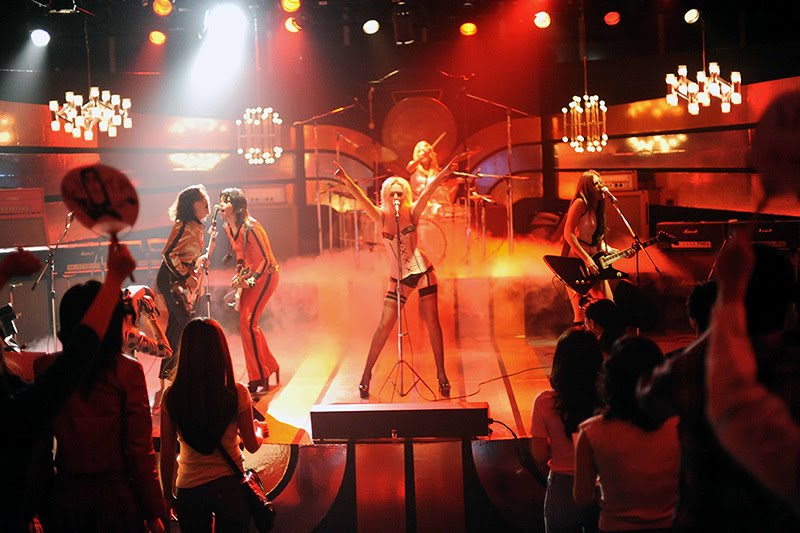
The 70's: a decade I haven't' talked about often. Let me correct that by presenting The Runaways (2010) on this fine Movie Monday. This movie chronicles the band The Runaways from their debut in 1975 to their breakup in 1977 following the overwhelming reaction of fans on their Japanese tour.

What does this mean for us costumers? Plenty of eye candy 70's Rocker fashion!

The original Runaways

By the way, look at this original picture and notice if you please the lingerie worn by Cherie Currie. Now look at this still from the movie:

The Runaways (2010)

I love it when I know the Costume Designer did their research.

On the actor's level, it's also nice to see Dakota Fanning (Cherie Currie) all grown up and Kristen Stewart (Joan Jett) act. I know this may potentially sound mean, but I find she is demonstrating more talent in the 1:30 minute trailer for The Runaways (2010) than I have seen her show in two Twilight movies (my opinion anyways). Good for her!

Grab your leather vests, Rocker chicks, this movie is coming to you soon!

Costumes for this moie were designed by Carol Beadle; this is Carol's first credit as Costume Designer, according to IMDB (and I think she did an amazing job, based on what I have seen in the movie trailer).

Sunday, March 14, 2010

New Irish Dance Wig

Last Tuesday, my dance teacher surprised us with a request, that all her older dancers 9and I'm the eldest) have full wigs for our show... which is next Friday. With less than two weeks, I had to hurry. I spent a good amount of time shopping online and exchanging e-mails with sellers. Here is what I learned: wigs are freakishly expensive and so is shipping when you need it immediately (Okay, I already knew both these things, but they were confirmed to me once more).

Then on Friday the local Irish Dance supply seller (Faery Reel - lovely people) writes back saying if I want to, I can stop by her place and I can look through the bargain bin to see if anything fits my budget and hair colour. So yesterday, late in the afternoon, I head out with my daughter, drive two hours (because by local, I mean "The Greater Montreal Area"; it was still quite a long way from my home, but what choice did I have?) to go get myself a wig.


The wig I found is a double wig (twice as much hair as a normal human being would have) which is a 26" long, full head wig, with large elasticated cap, loose split curls and thick density fibre. I personally don't like split curls for Irish Dance wigs (I was really hoping for tight ringlets), but that was my only choice. The other wigs were either too small or the wrong colour.

Speaking of colour, it was a shock to me to realize how much darker my hair had gotten following my pregnancy. I used to be a Strawberry Blond, but this wig is Light Ash Brown with some Light Blond highlights and it's a near perfect match.

Gwenyver's Morgan Double Wig in Light Ash Brown / Light Blond - Front

This thing is huge. I wonder how it will feel when I dance in it?

Gwenyver's Morgan Double Wig in Light Ash Brown / Light Blond - Side

One thing is for sure: I'm going to look like a lioness with this huge main of hair.

Gwenyver's Morgan Double Wig in Light Ash Brown / Light Blond - Back

Of course, I,m sure you care to know how much Swiffer cost me (yes, I have nicknamed my wig "Swiffer"): 50$ and a half tank of gas. Seems like a lot? New, it costs 120$ on average. I guess the frizz caused by many hands checking the thickness of the curls (in it's previous life, Swiffer was a display wig) is well worth the bargain.

Stay tuned for pictures of me wearing it (and of our show next Friday).

Saturday, March 13, 2010

The Lady Gaga "Telephone" Phenomenon

Thursday, Lady GaGa's new music video, Telephone, took the world by storm. Some have said it's the biggest, most important video since Michael Jackson's Thriller. I don't know about that, but it is truly artistic, original, and one big marketing campaign for Virgin Mobile, Diet Coke, Miracle Whip and more (Ah, product placement... did I mention I have a degree in publicity? This is a dream come true for any brand). But more important than the hidden publicity was the large number of outrageous outfits worn throughout the video (and the reason I'm gaga for GaGa!).

Found at TrendLand were the following pictures and their fashion design credentials. (For the original article, go to
Telephone by Lady Gaga feat. Beyoncé [Fashion Credits])


Custom made crime scene tape by Brian Lichtenberg

Kind of reminds you of Leeloo's white tape outfit in The Fifth Element (1997).

Custom made outfit by Jean Charles de Castelbajac, sunglasses by Mercura

I doubt this style will ever be adopted by any penal establishment.

Custom made chain and jumpsuit by Viktor & Rolf, cigarette sunglasses and shoes by Haus of GaGa

My eyes itch when someone smokes within five metres of me; can you imagine having that many cigarettes BY YOUR EYES?!

Vintage sunglasses by Chanel

Some classics are classics for everyone.

Studded jacket by Search and Destroy

In keeping with a current trend, but oh! so over the top for anyone but her.

Studded outfits by Haus of GaGa

I bet you that would ruin a silk shirt.

Vintage hat and outfit by Thierry Mugler

Oh my, she's covered! She almost looks like a regular posh lady! (Except for the yellow hair.) I love black and white together, and I love hats. This is my favourite outfit of thw

e video.

Telephone hat by Fred Butler

See, everyone needs turquoise!

Hat and dress by Rachel Barrett telephone hair piece by Danilo

Again, I am reminded of the aesthetics in The Fifth Element (1997). I wonder if she gets inspired by that movie sometimes...

Lady GaGa outfit by Haus of GaGa, boots by Christian Louboutin; Beyoncé outfit by Oscar Olima

I guess I could call that look Trash Wonder Woman?

Leopard outfit by Haus of GaGa

If your cab driver ever looks like that, wait for the next one!

Cowboy hat outfits by Emilie Pirlot

I guess that's a Texan burqa?

For those interested, you can watch the video and see all of those weird costumes and other little details in movement. Enjoy!

Friday, March 12, 2010

How to Dress in 18th century style

It's not always easy to know how to put on and wear clothes from another era (see yesterday's post Pockets!). With this in mind, I thought I might share with you the proper way to get dressed in 18th century style.

The following
article comes from an amazing website, La Couturière Parisienne. It is well illustrated and better than anything I could do (since I cheat in my 18th century design by using hook & eye tape for the front closure). I did re-word some of the passages to make them clearer, in my perception, but it is very close to the original, to which I give all the credit.

How to Dress in 18th century style

For decency reasons, we start with a lady who already wears her shift, cap and stockings. Can't be having pictures of women without a cap on, now, can we!

The over-knee stockings are fastened with garters just below the knee. (To learn why it is tied below the knee and not above it, see The Stocking Page at La Couturière Parisienne.)

If she hasn't done so yet, the lady now has to put on her shoes, unless she intends to wear mules (as she does here) or has a maid who will fasten the
shoe buckles. As soon as she has the stays on, she will hardly be able to bend down to fasten them herself.

Now would be the time to tie on the decency skirt or under-petticoat. (In the pictures, it was left out for simplicity reasons.)

Then, the stays come on. Remember to use spiral lacing! Before tightening the lace, pull the shift straight so that its neckline sits just right. See to it that the shift fabric is distributed evenly all around. (Find more information about putting on stays here.)

Next come the pocket hoops. Pocket hoops are a smaller variant of the hoop skirt that was worn after c. 1750. They also doubled as pockets.

If a proper pannier is worn, you first tie on a pair of pockets, and then the panniers. Pockets, panniers and pocket hoops all have narrow waistbands which is tied in a bow at the front.

To make sure that the hoops do not show through the skirt, one or more petticoats should be put on top. They don't have to be very thick, quite the contrary: they should be light, except perhaps in winter. A large number of folds and the stiffness of the fabric hides the hoops best. Therefore, the under-petticoats should have as much fabric as the visible petticoat. Two petticoats of light fabric work better than one petticoat of heavy fabric.

Now the visible petticoat, the skirt, is put on. The waistband is in two parts (same as for the under-petticoats, by the way) and long enough that each half goes all around the waist to be tied in a bow. The back half is tied on first...

... and then the front half. This allows the back and front half of the skirt to overlap each other, allowing for changes in a person's girth or for use by more than one person. Since the front half lies on top of the back, the pocket slits are easily accessible from behind even if there is a considerable overlap.

Next, the stomacher is fastened to the front of the stays: it is pinned on using the flaps on the side of the stomacher.

One question I am often asked is "Was this not dangerous?". Well, when putting the needles in you do have to be careful not to go to deep, lest you either hit the boning and break the pin off, or worse, miss the boning and hit the flesh! The pins should be put in vertically, shallowly, and the tip should come back out the fabric flap. If the stays are stiff enough, this will happen almost automatically. As the robe will be on top, the pins will be well hidden both from sight and from skin.

Now the robe comes on; it is put on like a coat. The front edges are placed onto the stomacher and pinned to it. The best way to do that is to fold away the dress, place the pins underneath – as close to the front edge as possible – and then fold the dress back to hide them.

These needles, too, aren't dangerous if they are put in shallowly from the top down and hidden under the gown. Just to be sure to have the tip go very shallowly back out through the fabric. It is a higher probability that you will scratch yourself or ruin your engageantes by brushing them against a pin tip lying outside the fabric than there is of driving a pin into the skin of your torso. The stays will protect you from the pins.

A woman of simple means would wear a jacket rather than a gown in everyday life. The jacket is often a shorter version of the dress and is put on in the same way.

When wearing a robe à la française, a close fit must be provided by tightly pulling the strings hidden under the back pleats of the dress. Pinning the front edges is easier if these strings are loose. Now is the time to have them re-fastened by a maid. This is another feature that makes the française so well suited for more than one dress size. My model here is at least two sizes away from the person the dress was originally made for.

With a robe à l'anglaise or à la polonaise, this is neither necessary nor possible since both have close-fitting backs anyway.

Add a fichu to cover the neckline, and the lady is fully dressed. For business outside the home, she may also add a mantelet or pelisse of black taffeta.

But what if it is really cold? I have not found much in the way of winter clothing yet, but I suspect that both mantelets and pelisses were not just made of taffeta, but also of wool and possibly, lined with fur. Commoners may have worn knitted triangular wraps as well.

For Society occasions, the fichu was left off, an elegant hairdo replaced the cap, and of course, the lady would put on a silk robe rather than this relatively simple cotton one.

Source: http://www.marquise.de/en/1700/howto/frauen/18anziehen.shtml

Thursday, March 11, 2010

Pockets!

I knew there had to be an advantage to going back to my day job (which has nothing to do with costumes, fashion or even sewing), other than paying the bills; I got to find a picture I thought I had lost (and had been wishing to share with you since last summer).

Quick background story: Fall of 2008, the company where I work organizes it's annual Leadership week-end. Since 2008 was also Québec City's 400 years anniversary, they had said week-end in Québec City and used the historic anniversary as a theme. After the week-end, they bring back pictures and share them with everyone. That is when I found this:

18th Century maid

This is a photo of one of the entertainers hired for the week-end. She clearly plays the part of some sort of 18th century maid. Her costume is okay, or so it seems, until you look closely. See the white pieces of fabric at her side, under the basque of her bodice, but over the skirt? Those are pockets. One wears those UNDER a skirt!

Seriously, the first time I saw this photo, I laughed so hard, people were wondering why, so I had to explain, comparing this costuming faux pas to wearing one's underwear over one's clothes. (Okay ,so they didn't find it as funny as I did, but I guess they couldn't see it as I did).

I'm truly sorry to this poor entertainer, but really, might I suggest a little research?

To everyone else, I'm glad to be sharing this joke with you all.

Wednesday, March 10, 2010

Wednesday Weekly Wishlist: 18th Century Hoodie

And just like that, I’m back to the subject of 18th Century dresses. Someone I follow on DeviantART (Idzit, who makes amazing, amazing dresses – do check them out) recently told me I should defiantly try my hand at a pattern from Janet Arnold’s book Patterns of Fashion 1: Englishwomen's Dresses and their Construction, c. 1660-1860. I really feel like making a jacket right now (it takes less fabric and I could use some of my leftovers), so I started to flip through that book and I fell in love with this one:

A white quilted satin jacket with a hood and a matching petticoat, c. 1745-60, Snowshill Manor (page 30).

I call it the 18th Century Hoodie.

I hope to make it for this summer’s
Les Fêtes de la Nouvelle-France. I’m thinking of using my usual 1$ / metre jacquard for the hooded jacket, dye it yellow and wear it with a pink skirt (either the linen one or the satin one, I haven't made up my mind). Colour wise, it would look a little like this:

Kirsten Dunst as Marie Antoinette, Marie Antoinette (2006)

After I had begun planning this outfit (and this post), Idzit posted pictures of her own version of this dress (which is much more accurate to the description Janet Arnold made of it than anything I intend to make). She very graciously gave me permission to post it here.

Photography/editing: Chocomalk

Here is what she had to say about this ensemble:

This outfit is made of a cream-coloured quilted cotton lined with a cotton broadcloth (in the jacket). I'm wearing a bumroll underneath because I don't have a hooped crinoline, but the effect I find is just as lovely and probably more convenient.

The muff is fairly high-tech; it's lined with polar fleece and Thinsulate©! Not to mention there's a little pocket inside for a mirror, lipstick, cell-phone, wallet... blunderbuss - whatever! I did not use a pattern for the construction of the muff, it was fairly straightforward. I might one day post a tutorial on how to make one though...

"The white ruffles of a chemise would have shown below the flounce at the end of the sleeve. This suit would probably have been worn for travelling... A handkerchief would have been worn at the neck. The skirt would have probably been supported by a dome-shaped hoop-petticoat."-Janet Arnold.

Absolutely beautiful. Again, I really want to thank
Idzit for letting me share her work here.

I’m really itching to start working on an 18th century project. Anything, just 18th century.