Instead of watching Memoirs of a Geisha (2005) for a third time in a row (what, did you think my latest Japanese phase was over? ), I decided to watch a classic Japanese movie instead (which I found in my Sweetheart's DVD pile while looking for something else): Kagemusha (1980) by Akira Kurosawa. The French translation is awful, but the cinematography is magnificent.

Kagemusha (1980)
Did I ever mention that during my Film Study Major, I was in charge of Cinematography for my team's movie? Well I was (I would have preferred the job of costume designer, but it was already taken). I was taking photography classes at the time and as I came from an Art DEC, I had an eye for composition that most of my other team members didn't. By the way, our movie "Un Homme Ordinaire" won both prizes it was eligible to win at the end of year Gala.
 Kagemusha (1980) - Dream Sequence
Back to Kagemusha: the movie is set in 16th century Japan and is inspired by Takeda Shingen, a warlord who died in 1573, though the events depicted after his death are fiction written by the movie's director. The story tells of a lower-class criminal who is taught to impersonate a dying warlord in order to dissuade opposing lords from attacking the newly vulnerable clan. The costumes, designed by Seiichiro Hagakusawa are inspired by the clothes worn by the Warrior class in the Azuchi -Momoyama period (1568–1603).
Sadly enough, my Costume History classes in Fashion school did not include foreign fashion; it was focused on Western clothing only. While I do understand the time constraint issue in trying to go through thousands of years of fashion in one or two semesters, the fact remains that Costume History classes are meant to help you recognize certain styles in modern trends (or at least this is how my teacher put it) and these trends will every so often be inspired by foreign fashion, whether in the print of the fabric or in the cut of clothes. I am not blaming my teacher here (I like her too much for that), but the program, which I believe needs to be revised a little.
So I will try to fill in the gap a little.

Kagemusha (1980)
So what did a warrior wear in the Azuchi -Momoyama period? When at home, the warrior lord might wear a Suo, a short coat not unlike a Hitatare, and Hakama, pleated pants. The fashion of the time called for men to shave the top of their heads and for the hair to be tied up into a small Mage (bun like piece of hair in the back). This hairstyle is called Sakayaki.

Statue of Takeda Shingen, Daimyo of Sengoku (1521-1573) in Suo and Hakama - Front View Statue of Takeda Shingen, Daimyo of Sengoku (1521-1573) in Suo and Hakama - Back View
 Kagemusha (1980)
In the movie, we also see quite a few men dressed in Kosode, a Kimono like garment with smaller sleeves, Hakama and Katiginu, a sleeveless jacket.
The Kosode, literally meaning "small sleeves" was worn by both men and women. It first appeared as an undergarment during the Heian period (794 - 1185), but during the period studied here, it was worn as an outer garment as well.
 Warrior General in Kataginu and Hakama - Front View
 Warrior General in Kataginu and Hakama - Back View
 Kagemusha (1980)
The movie also has a few scenes with women, mainly concubines. The first time the Kagemusha (Shingen's double) meets the concubines, two of them serve him dinner and each displays a different style. By the way one of them is played by Kaori Momoi, who plays Mother in Memoirs of a Geisha, but I have no idea which one she is.
Women of the upper warrior cast wore floor length Kosode, often a couple layers of them, held close by thin hoso-obi belts, and an Uchikake coat. The hairstyle, called Suberakashi, is worn straight and long, except for two short pieces on either side of the face which are cut short; these are called binsogi no kami. Fashion of the time required women to pluck out or shave their eyebrows. These were redrawn higher on the forehead.
In the picture showing the concubines, the one on the left wears her Uchikake hanging from her shoulders as such:
 Woman of the upper warrior class in ceremonial dress, with Uchikake outer-garment - Front View
 Woman of the upper warrior class in ceremonial dress, with Uchikake outer-garment - Back View
The concubine to Shingen's right wears her Uchikake wrapped around the waist, in the summer fashion.
 Woman of the upper warrior class in formal costume for summer, with Uchikake wrapped around the waist - Front View
 Woman of the upper warrior class in formal costume for summer, with Uchikake wrapped around the waist - Back View
And there you have it: a little overview of the costumes in Kagemusha. Of course, I did not include armour, as I am no expert on the subject, nor did I mention the clothes worn by the peasants.
If you would like more information on 16th century Japanese fashion, there are plenty of web pages on the subject, many of them by SCAdians as the SCA accepts any culture as long as it is pre-17th century. The one I recommend is Woderford Hall by Lisa Joseph.
For those of you who might want to make yourselves a Japanese costume, here is a little gift: Free Patterns! I found the links on Lisa Joseph's page The Kosode: a Japanese garment for the SCA period (on which she also explains how to make one).
To make a Hitatare, go to: http://www.sengokudaimyo.com/katchu/graphics/patterns/hitatare.PDF?43,13
To make Hakama, got to: http://www.sengokudaimyo.com/katchu/graphics/patterns/hakama1.PDF?58,15
The Hakama pattern will be especially useful if you also like to do Anime Cosplay.
By the way, all of the statuette pictures came from the Kyoto Costume Museum (not to be mistaken with the Kyoto Costume Institute). They have a very large collection pictures of statuettes dressed in the garb of different eras of Japan, from prehistory to modern times. Each costume is very well described with words in Japanese and their literal meaning in English. It is an incredible resource.
I guess I have one more reason to want to go to Kyoto!
 Not sure what to wear? Well first of, let me tell you I'm a little disappointed, considering the number of times I've mentioned 18th century clothing. What is generally considered New France period (history is always somewhat opened to interpretation) is from 1608, the year when Samuel de Champlain founded Québec City, and 1763 when the Treaty of Paris ceded New France to Britain. Meaning New France went through kings Louis XIII, XIV and XV, which is important to know when planning the style you intend to wear. Of course, you might want to keep in mind that there were not many (if any) noble ladies in fancy dresses in 1608, but by 1750, Bourgeoisie had settled in.
 La Jeune Bourgeoise (The Young Noblewoman) by Sonia Ruel, Class of 1997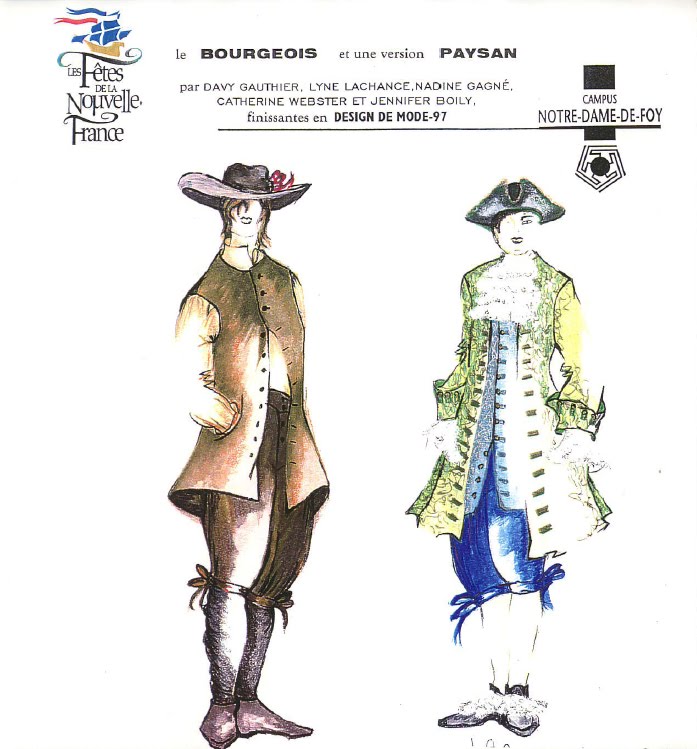
 La Bourgeoise (The Noblewoman) by Isabelle Pouliot, class of 1997
 L'habitante de Stadacone (Woman of Stadacona) by Nancy Boissonneault, class of 1999
 Isabeau by Marie-Josée Rioux, Class of 1999
 La Paysanne (The Peasant) by Yannick Auclair, Class of 1997
 Katherine la Paysanne (Katherine the Peasant) by Julie Castonguay, class of 1999


